
Learn
New to weaving? Start here
You don't need to know any of this before your first Thursday. But people tell us it helps to have heard the words once before someone at the loom says “check your sett”.
Words you'll hear
- Warp
- The threads stretched lengthwise on the loom before you start. They have to be strong and evenly tensioned.
- Weft
- The thread you pass across, back and forth, to make the cloth.
- Shaft
- A frame holding a group of heddles. Lifting a shaft lifts every warp thread threaded through it. Our club looms have four.
- Heddle
- A wire or string with an eye in the middle. Each warp thread goes through one heddle on one shaft.
- Shed
- The gap between raised and lowered warp threads that the shuttle goes through.
- Reed
- The comb-like part that spaces the warp and beats the weft into place.
- Sett
- How many warp threads per inch (or per 10 cm). Too close and the cloth goes stiff; too open and it's sleazy.
- Pick
- One pass of weft across the warp.
- Selvedge
- The side edges of the cloth. Neat selvedges come with practice and nobody has them in their first year.
Reading a draft
A weaving draft is a small map of the cloth. It looks like a crossword at first and becomes obvious after ten minutes.
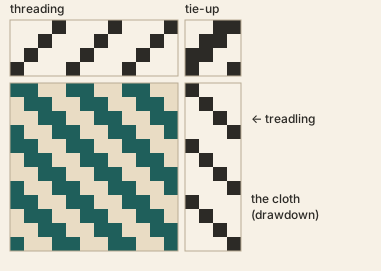
- Threading (top): each column is one warp thread, and the black square shows which shaft it goes on. Shaft 1 is the bottom row.
- Tie-up (top right): which shafts each treadle or lever lifts.
- Treadling (right): each row is one pick, and the black square shows which treadle you press.
- Drawdown (the big grid): what the cloth will look like. Coloured with the warp where the warp is on top, with the weft where the weft is on top.
Every draft on our drafts page uses the same layout.
A good first project
We start almost everyone on a tea towel in cotton, about 45 cm wide and 70 cm long, in plain weave. It's small enough to finish in three or four Thursdays, useful enough that you'll keep it, and cotton shows you exactly what your beat is doing, which is humbling but helpful.
You'll need about 200 g of 8/2 cotton, which we usually have in the stash. Sett it at 20 ends per inch. Leave a good long fringe for hemstitching; it's easier to trim than to add.
What to bring
- Small sharp scissors and a tape measure.
- A notebook. You will forget your numbers.
- Patience with yourself. The second project is always much better.